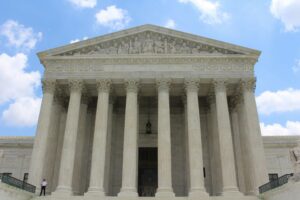
On June 25, 2026, the Supreme Court lifted the lower court injunctions that had prevented the terminations from taking effect while litigation continues, allowing DHS to proceed with ending TPS for Haiti and Syria. The vote was 6 to 3. The decision came in Mullin v. Doe, consolidated with Trump v. Miot, Nos. 25-1083 and 25-1084.
The ruling does not end the underlying lawsuits. It removes the court orders that had kept TPS protections in place while those lawsuits move forward. As a practical matter, the terminations can now take effect. Hundreds of thousands of people are affected.
What TPS Is
Congress created Temporary Protected Status (TPS) in 1990. The program lets the Secretary of Homeland Security designate a country whose nationals cannot safely return home. The triggers are ongoing armed conflict, a natural disaster, or other extraordinary and temporary conditions. People covered by a designation can live and work in the United States and are protected from removal.
The Secretary must review each designation at least every 18 months. The statute requires consultation with appropriate agencies, a review of country conditions, a determination on whether the conditions still qualify, and publication of a notice in the Federal Register.
The Two Designations
The Secretary designated Haiti for TPS in 2010 after a magnitude 7.0 earthquake. The Secretary designated Syria in 2012 because of conditions tied to the Assad regime. Both designations were extended for years.
In 2025, the current administration moved to end both. The Secretary published a termination notice for Syria in September 2025. The Secretary published a termination notice for Haiti in November 2025, with the termination set for February 3, 2026. These decisions were signed by then-Secretary Kristi Noem.
Haitian and Syrian TPS holders sued. Federal courts in Washington, D.C., and New York paused the terminations. Two federal appeals courts declined to step in. The government then asked the Supreme Court to lift those orders.
Holding One: Courts Cannot Review Most TPS Claims
The TPS statute contains a judicial-review bar. It states that there is no judicial review of any determination of the Secretary with respect to the designation, or termination or extension of a designation, of a foreign state. See 8 U.S.C. 1254a(b)(5)(A).
The challengers argued that this bar covers only the final decision, not the steps leading to it. They said the Secretary skipped a required step. Specifically, they said she did not properly consult other agencies about country conditions before ending the designations.
The Court rejected that reading. Writing for the majority, Justice Alito held that the word “determination” is broad. It can mean the final decision or the whole process leading to it. Under either meaning, the bar covers the challengers’ claims. The Court held that the TPS statute bars judicial review of the non-constitutional claims raised in these cases because they challenged the Secretary’s determination to terminate TPS designations.
This is the core of the decision. The Court’s interpretation of the TPS statute makes Administrative Procedure Act challenges to TPS designation and termination decisions significantly more difficult to bring. That includes claims that the Secretary failed to consult with other agencies, ignored relevant evidence, or acted in an arbitrary and capricious manner.
Holding Two: The Equal Protection Claim Is Unlikely to Win
The Haitian challengers also raised a constitutional claim. They argued that the termination was motivated by race. Constitutional claims are not covered by the statutory bar, so the Court reviewed this one.
The Court found the claim unlikely to succeed. It pointed to a race-neutral explanation that the challengers themselves had offered. The Court noted the challengers’ own allegations that the administration has adopted a general policy of terminating TPS designations when they come up for review. The Court noted that the administration had sought to terminate every TPS designation that came up for review, thirteen in total. The Court reasoned that a record of ending every designation undercuts the claim that Haiti was singled out because of race.
Because the challengers were unlikely to win on either ground, the Court held they were not entitled to stay protected during the litigation.
The Dissent
The court’s three liberals dissented, with Justice Kagan writing the opinion and Justices Sotomayor and Jackson joined her. She argued that the statute bars review of the Secretary’s determination but not the separate procedural steps the law requires before that determination. She also argued that the equal protection evidence was strong enough to support interim relief. She warned that affected families face severe and lasting harm.
What This Means
The decision is about interim relief, not a final judgment. The cases return to the lower courts for further proceedings. But the practical effect is significant.
As the termination becomes effective, affected individuals generally lose TPS-based protection from removal and associated employment authorization unless they have another independent basis to remain or work in the United States.
Second, the ruling reaches well beyond these two countries. The Court’s reasoning is likely to affect future challenges to TPS terminations because it substantially narrows the availability of APA-based procedural challenges to TPS designation and termination decisions.
Third, constitutional challenges remain possible in theory. But the Court’s treatment of the equal protection claim shows how steep those challenges will be.
People who hold TPS from any country should pay close attention to their designation’s current status and expiration date. Some individuals may qualify for family-based immigration, employment-based immigration, asylum or withholding of removal, adjustment of status, or other humanitarian protections. Eligibility depends entirely on the individual’s circumstances.
Talk to a Qualified Attorney
If you or a family member holds TPS and is unsure what this ruling means for your situation, speak with a qualified immigration attorney about your options.
Individuals who currently hold TPS should not wait until their employment authorization expires or removal proceedings begin before exploring other immigration options. Early legal advice may preserve opportunities that become unavailable once TPS protection ends.
The right path depends on your individual circumstances, and acting early matters. Individuals should not assume that the end of TPS means they have no remaining immigration options. Contact Extraordinary Immigration PLLC at info@eoimmigration.com or call (305) 391-2105 to schedule a consultation.